Travelling on the Ship

The captain of a ship was telling this interesting story: "We travelled the sea far and wide. At one time, two of my sailors were standing on opposite sides of the ship. One was looking west and the other one east. And at the same time, they could see each other clearly." How can that be possible?


Similar Riddles

If,

6 / 7 = 2
3 / 9 = 7
8 / 2 = 6

Then

4 / 5 = ?

Asked by Neha on 15 Apr 2025


Things are just as they seem, right? Well, check again.
Can you count the number of tigers in this picture ?

Count The Tigers

Asked by Neha on 21 May 2021

A doctor and a boy were fishing. The boy was the doctor’s son, but the doctor was not the boy’s father. Who was the doctor?

Asked by Neha on 04 Mar 2022


Can you count the number of lines in the below picture?

Count The Number Of Lines

Asked by Neha on 27 Dec 2023

Peter wakes up daily to pick up his cycle and crosses the border between Spain and France daily with a bag on his shoulder. He is investigated daily by the officials but they don't find anything suspicious.

If we tell you that he is smuggling something what would it be?

Asked by Neha on 25 Jun 2024

In the formation, you can see a few arranged matchsticks. Can you form three squares by moving just three matchsticks?

Three Squares Matchsticks Riddle

Asked by Neha on 08 Aug 2026


What's the best place to go shopping in the ocean?

Asked by Neha on 31 Oct 2024

81 x 9 = 801. What must you do to make the this equation true?

Asked by Neha on 03 Oct 2021

I possess two wires. Both of them have an inconstant thickness but both of them burn completely in sixty minutes. The problem is that I want to measure forty-five minutes while using these two wires.

How can I measure if cutting the wire in half is not possible due to non-homogeneous construction?

Asked by Neha on 14 Nov 2026


In the given figure, move three matchsticks so that the resulting figure contains two rectangles.
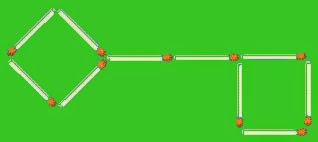

Matchsticks Rectangles

Asked by Neha on 25 Jul 2024

Hot Articles

Amazing Facts

Crossword puzzles

In the 1920s, people feared that crossword puzzles would contribute to illiteracy.