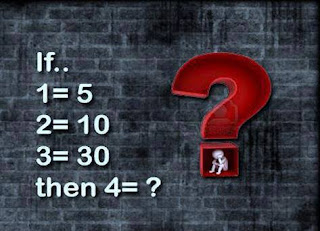
A bag contains 64 balls of eight different colours. There are eight of each colour (including red). What is the least number you would have to pick, without looking, to be sure of selecting 3 red balls?
There is a hypothetical state between the USA and Mexico border 'Tango'.
Here 70 percent of the population have defective eyesight, 75 percent are hard of hearing, 80 percent have Nose trouble and 85 percent suffer from allergies, what percentage (at a minimum) suffer from all four ailments?
You order chicken wings at KFC in the boxes of 6, 9 and 20. What is the largest number of wings that you cannot obtain by buying in any combination of the boxes?
1. How can we put an elephant in the refrigerator?
2. How can we put a Giraffe in a refrigerator?
3. The king of the jungle invites all the animals to a party everyone comes except for one animal, which animal?
4. You come to a crocodile-infested lake, you can't go around it, you can't co under it and you can't go over it, how do you get across?
There is a box in which distinct numbered balls have been kept. You have to pick two balls randomly from the lot.
If someone is offering you a 2 to 1 odds that the numbers will be relatively prime, for example
If the balls you picked had the numbers 6 and 13, you lose $1.
If the balls you picked had the numbers 5 and 25, you win $2.
It has five wheels, though often think four, You cannot use it without that one more, You can put things in it, you can strap things on top, You can't find it in the market, but you can still go shop. What is it?
Three friends decide to distribute the soda cans they had among them. When all of them had drunk four cans each, the total number of cans that remained was equal to the cans each one of them had after they had divided the cans.
Can you calculate the total number of cans before distribution?
Two friends were stuck in a cottage. They had nothing to do and thus they started playing cards. Suddenly the power went off and Friend 1 inverted the position of 15 cards in the normal deck of 52 cards and shuffled it. Now he asked Friend 2 to divide the cards into two piles (need not be equal) with equal number of cards facing up. The room was quite dark and Friend 2 could not see the cards. He thinks for a while and then divides the cards in two piles.
On checking, the count of cards facing up is same in both the piles. How could Friend 2 have done it ?
The day before the 1996 U.S. presidential election, the NYT Crossword contained the clue “Lead story in tomorrow’s newspaper,” the puzzle was built so that both electoral outcomes were correct answers, requiring 7 other clues to have dual responses.