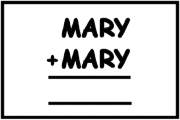
We know that money can be names differently for the purpose it is used for. Some of the examples of money given at following places or for following activities:
In temple = Daan
In school = Fees
During marriage = Dowry
For divorce = Alimony
Paying government = Tax
In court = Fine
Employer to employee = Salary
To kidnappers = Ransom
For illegal reason = Bribe
To civil servant retirees = Pension
Do you know what do we call the money a husband gives to his wife?
A man fell off a smuggling boat into deep water. He could not swim and he was not wearing anything to keep him afloat. It took 30 minutes for the people on the boat to realize someone was missing. The missing man was rescued two hours later on the return trip. Why didn't he drown? Note:- He didn't know swimming, the sea was deep, and He wasn't holding anything
Two natural numbers have a sum of less than 100 and are greater than one.
John knows the product of the numbers and Jacob knows the sum of numbers.
The following conversation takes place between them:
John: 'I am not aware of those numbers.'
Jacob: 'I knew you wouldn't be. I am not aware myself.'
John: 'Now I know them!'
Jacob: 'Now I know them, too!'
If a shopkeeper can only place the weights on one side of the common balance. For example, if he has weights 1 and 3 then he can measure 1, 3 and 4 only. Now the question is how many minimum weights and names of the weights you will need to measure all weights from 1 to 1000? This is a fairly simple problem and very easy to prove also.
In 2007, a puzzle was released and $2 million prizes were offered for the first complete solution. The competition ended at noon on 31 December 2010, with no solution being found. Wiki