Edward James went for tiger hunting. It was not his lucky day. He got six tigers without heads, nine tigers without the tail and eight cut in two halves. How many tiger did he hunted ?
Jack was having a candle light dinner with his girlfriend. Suddenly a cold gush of wind entered through the open window and three of the ten candles were extinguished. Assuming that none of the other candles were extinguished. How many candles are they left with in the end ?
Outside a massage parlour, there is a board that reads "I only massage those who do not massage themselves." Reading the above statement, does the masseur massage himself?
John was born on March 5, 1970, in Delhi, India. Jacob was born 25 days before John. The year when they took birth, Republic Day fell on Monday. Can you find out on what day was Jacob born?
What is Luis Suarez's (Soccer Player) favorite tea?
Why are televisions attracted to people?
Get total of 120 by using five zeros 0,0,0,0,0 and any one mathematical operator. Do you ?
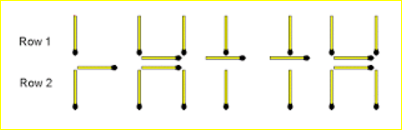
Can you decipher the two rows to find the hidden word?
By using 'because' continuously three times, can you make an English statement ?
In an office's desk, you find a unique method that shows the current day of the month. Two numbered cubes are used to depict the current date. Can you find out the numbers on both the cubes so that each date can be mentioned using them? Please note that you have to use both the cubes to display any date. Thus the 1st day must be represented by 01 and so on.
Imagine you are in a room with no windows or doors. How will you get out?
In the 1920s, people feared that crossword puzzles would contribute to illiteracy.