A beggar on the street can make one cigarette out of every 6 cigarette butts he finds. After one whole day of searching and checking public ashtrays the beggar finds a total of 72 cigarette butts. How many cigarettes can he make and smoke from the butts he found?
Using the clues below, what four numbers am I thinking of?
The sum of all the numbers is 31.
One number is odd.
The highest number minus the lowest number is 7.
If you subtract the middle two numbers, it equals two.
There are no duplicate numbers.
If a shopkeeper can only place the weights on one side of the common balance. For example, if he has weights 1 and 3 then he can measure 1, 3 and 4 only. Now the question is how many minimum weights and names of the weights you will need to measure all weights from 1 to 1000? This is a fairly simple problem and very easy to prove also.
You have 1023 apples and 10 bags. You have to distribute these apples in these 10 bags in any way you choose. But when I ask for a certain number of apples you have to give them in terms of bags without transferring the apples from other bags. How do you distribute the apples?
What does man love more than life, and hate more than death or mortal strife; that which satisfied men want; the poor have, and the rich require; the miser spends, the spendthrift saves, and all men carry to their graves?
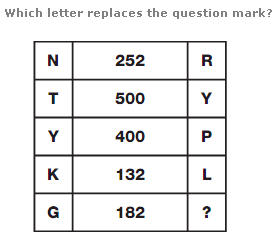
If we tell you that there is a relation between the numbers and letters in the given figure, can you analyze it and find the missing letter in the last box?
The day before the 1996 U.S. presidential election, the NYT Crossword contained the clue “Lead story in tomorrow’s newspaper,” the puzzle was built so that both electoral outcomes were correct answers, requiring 7 other clues to have dual responses.