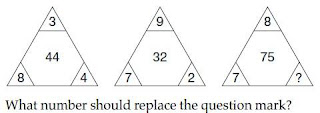
John is on an island and there are three crates of fruit that have washed up in front of him. One crate contains only apples. One crate contains only oranges. The other crate contains both apples and oranges.
Each crate is labelled. One reads 'apples', one reads 'oranges', and one reads 'apples and oranges'. He know that NONE of the crates have been labeled correctly - they are all wrong.
If he can only take out and look at just one of the pieces of fruit from just one of the crates, how can he label all of the crates correctly?
The interviewer has given me 100 marbles(50 white and 50 black) and two empty boxes.
He then told me that he will leave the room and i need to place all the marbles in two boxes.
And When he come back, he will draw a marble from any of the two box and if the marble is white I will be hired.
Also
* No box can be empty.
* All 100 marbles must be placed in one of the two boxes.
You are provided with a grid (as shown in the picture). Can you fill the squares with numbers 1-8 in a manner that none of the two consecutive numbers are placed next to each other in any direction (vertically, horizontally or diagonally?)
A Shopkeeper sold a few chickens to four different customers on a particular day. It was such that each customer purchased half of the remaining chickens and half the chicken more.
Can you find out how many chicken were sold by the shopkeeper on that day if we tell you that the fourth customer bought a single chicken ?
There are two beautiful yet remote islands in the South Pacific. The Islanders born on one island always tell the truth, and the Islanders from the other island always lie.
You are on one of the islands and meet three Islanders. You ask the first which island they are from in the most appropriate Polynesian tongue, and he indicates that the other two Islanders are from the same island. You ask the second Islander the same question, and he also indicates that the other two Islanders are from the same island.
Can you guess what the third Islander will answer to the same question?
10 people came into a hotel with 9 rooms and each guest wanted his own room. The bellboy solved this problem.
He asked the tenth guest to wait for a little with the first guest in room number 1. So in the first room, there were two people. The bellboy took the third guest to room number 2, the fourth to number 3, ..., and the ninth guest to room number 8. Then he returned to room number 1 and took the tenth guest to room number 9, still vacant.
How can everybody have his own room?