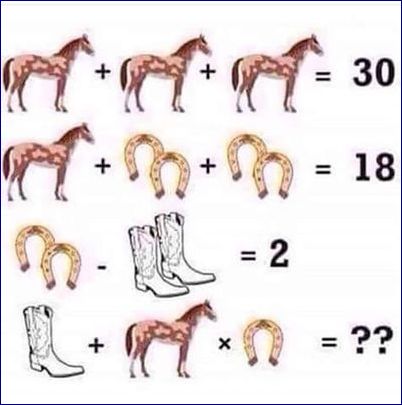
I am thinking of a five-digit number such that:
The first and last digits are the same, their submission is an even number and multiplication is an odd number and is equal to the fourth number. Subtract five from it and we obtain the second number. Then divide into exact halves and we get the 3rd number.
Seven Robbers robbed a bank and hide the coins in a lonely place.
They decide to divide the money equally the next morning. Two greedy robbers decided to cheat the others and reach the place at night. They equally divided the coins between them, one coin left. So they called another robber and then they decided to divide equally among the three. Sadly again one coin left. The same thing happened to the 4th 5th and the 6th robber.
However, when the 7th robber reached in the morning, they can divide the coins equally.
After teaching his class all about Roman numerals (X = 10, IX=9 and so on) the teacher asked his class to draw a single continuous line and turn IX into 6. The teacher's only stipulation was that the pen could not be lifted from the paper until the line was complete.
Five thieves looted a bank and they ran away in a car. The bank staff informed the police and they began the search of their car in their jeep. They found them on a road and chased them eventually catching them. The light that is used to fill the number plate was broken on the thieves' car. Also, the headlights of the jeep police were not working. How were the police able to catch the thieves then?
The day before the 1996 U.S. presidential election, the NYT Crossword contained the clue “Lead story in tomorrow’s newspaper,” the puzzle was built so that both electoral outcomes were correct answers, requiring 7 other clues to have dual responses.