
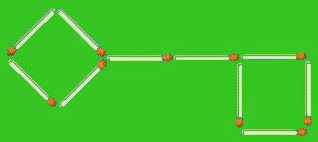
In the given figure, move three matchsticks so that the resulting figure contains two rectangles.
This is a game of Tic-Tac-Toe which you all might have played innumerable times. Here, we are playing with the black and white markers instead. Also, there is a bit change to the rules. The changed rules allow you to play just three times. After the three markers are put by each of the players, you can only slide your marker into an empty square that shares a common wall with the square that the marker is leaving. You can refer to the figure given. If this is the position of the game, the white's next move would be from 6 to 3. Now, whatever the black one does, the white one will move his marker from 5 to 2 and he will have a three in a row. What you have to decide is if both of the players are using a perfect strategy, will the white player (who plays first) always win? Or it will be the black one who will win always? Or every game will be a draw?