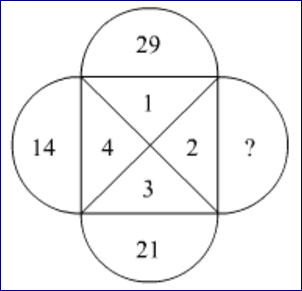
You have two jars of chocolates labelled as P and Q. If you move one chocolate from P to Q, the number of chocolates on B will become twice the number of chocolates in A. If you move one chocolate from Q to P, the number of chocolates in both the jars will become equal.
Can you find out how many chocolates are there in P and Q respectively?
* When we multiply three numbers, we will get the prime numbers.
* The difference between the second and the first number is equal to the third and second.
A man is lying dead in a field where no one is around. His head is split open and his legs are disfigured. Near to him, there is an unopened package. No living organism can be found anywhere at the crime scene.
We know that money can be names differently for the purpose it is used for. Some of the examples of money given at following places or for following activities:
In temple = Daan
In school = Fees
During marriage = Dowry
For divorce = Alimony
Paying government = Tax
In court = Fine
Employer to employee = Salary
To kidnappers = Ransom
For illegal reason = Bribe
To civil servant retirees = Pension
Do you know what do we call the money a husband gives to his wife?