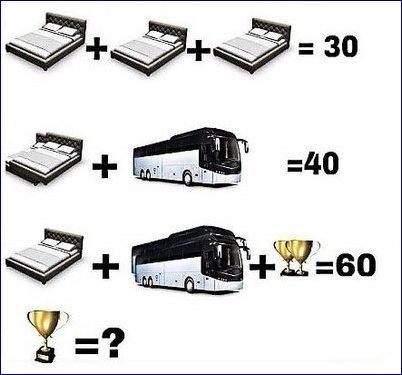
Analytical Riddle

John buys rice at Rs.60/kg from Britain and then sells them at Rs.5/kg in India. As a result of this, he becomes a millionaire. How come?


Similar Riddles

There is an English word that can be used up to four times in a row without modifying the spelling and form a valid grammatical sentence.

Do you know what word is that?

Asked by Neha on 18 Aug 2024


In Greek mythology, the Sphinx sat outside of Thebes and asked this riddle of all travellers who passed by. If the traveller failed to solve the riddle, then the Sphinx killed him/her. And if the traveller answered the riddle correctly, then the Sphinx would destroy herself. The riddle:

What goes on four legs in the morning, on two legs at noon, and on three legs in the evening?

Oedipus solved the riddle, and the Sphinx destroyed herself.

Asked by Neha on 26 Jul 2024

What does below rebus means ?

Break the Riddle

Asked by Neha on 15 Jan 2021


Replace the question mark with the correct number.

2 + 2= 4
3 + 3= 18
4 + 4= 48
5 + 5= ?

Asked by Neha on 15 Aug 2023

It begins where the time ends.
Its second is an expression of surprise.
Its third is a question.
Its fourth is urinate.
It ends with a drink.

Which country it is?

Asked by Neha on 21 Jul 2021

Can you count the number of seconds in a year?

Clue: You need to bother about calculation.

Asked by Neha on 06 Oct 2024


John can place six large boxes or nine small boxes into a carton.

Can you find out in how many cartons can he place sixty-six boxes in total?

Asked by Neha on 10 Jul 2023

what's the probability of getting a king or a queen from a pack of 52 cards?

Asked by Neha on 27 Sep 2024

What common phrase is represented by the below lines

Easy going:
Weak, 'I'm going.'
Tough, 'I'm staying.'

Medium going:
Weak, 'I'm going.'
Tough, 'I'm staying.'

Tough going:
Weak, 'I can't do it, I'm staying!'
Tough, 'Let's get going.'

Asked by Neha on 19 Nov 2024


What does this rebus means ?

Rebus For Kids

Asked by Neha on 02 Apr 2025

Hot Articles

Amazing Facts

Jigsaw puzzles

Jigsaw puzzles soared in popularity during the great depression, as they provided a cheap, long-lasting, recyclable form of entertainment.