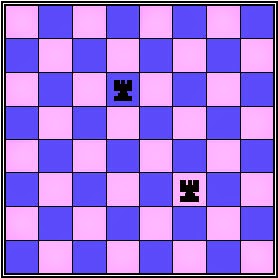
In the attached figure, you can see a chessboard and two rooks placed on the chess board. What you have to find is the number of squares that do not contain the rooks. How many are there?
Using four sevens (7) and a one (1) create the number 100. Except for the five numerals, you can use the usual mathematical operations (+, -, x, :), root and brackets ()
It's pretty hard to give up.
If you remove a part of it, you will be left with a bit.
Even if you remove another part, the bit still remains.
Remove one more and it still remains.
A man had five children. He had $100 with him to give to his children. He decided to start with the youngest child and then give $2 more than each younger child to his next elder child.
For example, if he gives $x to the youngest child, he will give $(x+2) to the next one, $[(x+2) + 2] to the next one and so on.
Can you find out how much did the youngest one receive?