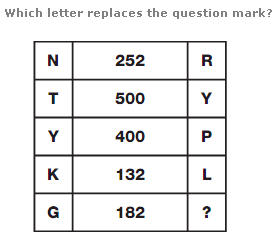
If we tell you that there is a relation between the numbers and letters in the given figure, can you analyze it and find the missing letter in the last box?
I left my campsite and hiked south for 3 miles. Then I turned east and hiked for 3 miles. I then turned north and hiked for 3 miles, at which time I came upon a bear inside my tent eating my food! What colour was the bear?
The interviewer has given me 100 marbles(50 white and 50 black) and two empty boxes.
He then told me that he will leave the room and i need to place all the marbles in two boxes.
And When he come back, he will draw a marble from any of the two box and if the marble is white I will be hired.
Also
* No box can be empty.
* All 100 marbles must be placed in one of the two boxes.
A thief enters a store and threatens the clerk, forcing her to open the safe. The clerk says, “The code for the safe is different every day, and if you hurt me you’ll never get the code.†But the thief manages to guess the code on his own. How did he do it?