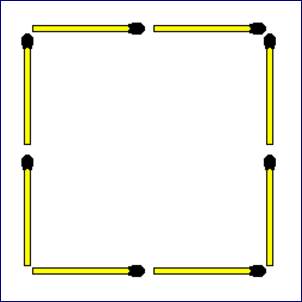
Number arrangement

Arrange the numbers 1, 2, 3, 4, 5, 6, 7, 8 and 9 above and below the division line in a manner that the thus formed fractions equal to 1/3.

(You can use one number only once)


Similar Riddles

Two friends were stuck in a cottage. They had nothing to do and thus they started playing cards. Suddenly the power went off and Friend 1 inverted the position of 15 cards in the normal deck of 52 cards and shuffled it. Now he asked Friend 2 to divide the cards into two piles (need not be equal) with equal number of cards facing up. The room was quite dark and Friend 2 could not see the cards. He thinks for a while and then divides the cards in two piles.

On checking, the count of cards facing up is same in both the piles. How could Friend 2 have done it ?

Game with Cards

Asked by Neha on 02 Mar 2021


Count the Triangle in the figure given below:

Can You Count

Asked by Neha on 04 Jul 2024

The following sentence is false. The preceding sentence is true.
Are these two sentences true or false?

Asked by Neha on 11 Jun 2026


What will be the best approach to finding all the prime numbers less than 75 that leave an odd reminder when we divide them with 5?

Asked by Neha on 12 Jul 2021

Without looking at a calendar, within a minute name, a boy's name using 5 consecutive 1st letters of 5 consecutive months

Asked by Neha on 22 Apr 2025

What runs around the whole yard without moving?

Asked by Neha on 14 May 2021


Count the number of triangles in the below picture?

Triangles Count

Asked by Neha on 12 Oct 2023

Today, I celebrated my 32nd birthday but I was born in 1972.
How is this possible?

Asked by Neha on 01 May 2025

I am an odd number. Take away a letter and I become even. What number am I?

Asked by Neha on 25 Feb 2022


A train leaves from point A for point B at 80 mph. After half an hour, another train leaves from point B for point A at 60 mph.

Which of the trains will be farther from point A when they meet ?

Asked by Neha on 23 Jan 2021

Hot Articles

Amazing Facts

Jigsaw puzzles

Jigsaw puzzles soared in popularity during the great depression, as they provided a cheap, long-lasting, recyclable form of entertainment.