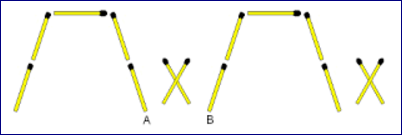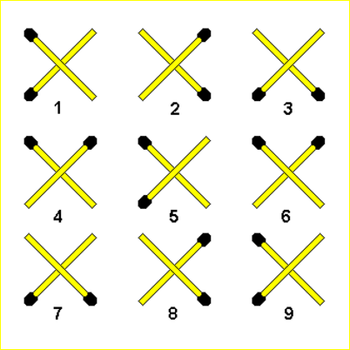
A cat, a dog and a monkey were stolen. 3 suspects got caught: Harish, Manoj and Tarun. All we know is each person stole one animal, but we do not know who stole which. Here are the investigation statements. Harish said: Tarun stole the cat. Manoj said: Tarun stole the dog. Tarun said: They both were lying. I did not steal the cat or the dog. Later on, the police found out the man who stole the monkey told a lie. The man who stole the cat told the truth. Can you find out who stole which?
Imagine a box with two cogwheels, one big with 24 teeth and one small with 8 teeth. The big one is firmly attached to the center of the box which means it does not turn or move while the small one rotates around the big one.
How many times do you think that the smaller wheel will turn compared to the box when it turns once around the big one?
If a shopkeeper can only place the weights on one side of the common balance. For example, if he has weights 1 and 3 then he can measure 1, 3 and 4 only. Now the question is how many minimum weights and names of the weights you will need to measure all weights from 1 to 1000? This is a fairly simple problem and very easy to prove also.
The Brit lives in the red house.
2. The Swede keeps dogs as pets.
3. The Dane drinks tea.
4. The greenhouse is on the immediate left of the white house.
5. The greenhouse’s owner drinks coffee.
6. The owner who smokes Pall Mall rears birds.
7. The owner of the yellow house smokes Dunhill.
8. The owner living in the centre house drinks milk.
9. The Norwegian lives in the first house.
10. The owner who smokes Blends lives next to the one who keeps cats.
11. The owner who keeps the horse lives next to the one who smokes Dunhill.
12. The owner who smokes blue masters drinks beer.
13. The German smokes Prince.
14. The Norwegian lives next to the blue house.
15. The owner who smokes Blends lives next to the one who drinks water.
Now, the question is…Who owns the fish?
The day before the 1996 U.S. presidential election, the NYT Crossword contained the clue “Lead story in tomorrow’s newspaper,” the puzzle was built so that both electoral outcomes were correct answers, requiring 7 other clues to have dual responses.