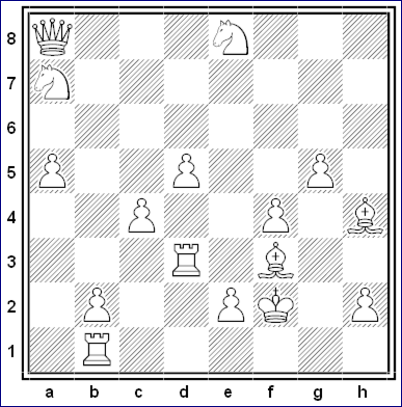
In the Chess Board picture below white army is arranged. You need to add a black army on the board such that no piece is under any threat.
Note: Army comprised of 1 king, 1 queen, 2 rooks, 2 bishops, 2 knights, and 8 pawns.
You walk into an old horror house. It has no power or plumbing. Once inside, you see three doors. Each door has a number on it. Behind each door is a way for you to die. Behind door number one, you die by getting eaten by a lion. Behind door number two, you die by getting murdered. Behind door number three, you die by an electric chair. You can’t turn back, so you have to go through a door. Which door do you go through?
Andrew’s doctor gives him three pills and tells him to take one every half hour. How much time will have passed by the time Andrew’s taken all three pills?
Jigsaw captured 100 people and make them stand in a circle and all these people are labelled as Person1, Person2, Person3... Person100. He made them play a crazy game in which Person 1 shot Person 2 and pass the gun to the next person and so on until one stands alive.
Once upon a time, there was a castle on a square island. The entire island was surrounded by a 14m wide trench. The Romans had wanted to invade the castle and had brought a few wooden planks along with them to facilitate themselves in crossing the moat. The planks were however found to be only 13m long.
The Romans still managed to cross the trench. How did they do it?
I come in different shapes and sizes.
Parts of me are curved, other parts are straight.
You can put me anywhere you like,
but there is only one right place for me.
What am I?
Artificial Intelligence has crushed all human records in the puzzle game “2048,” achieving a high score of 839,732 and beating the game in only 973 moves without using any undo.