John is a strange liar

John is a strange liar.

He lies on six days of the week, but on the seventh day, he always tells the truth.

He made the following statements on three successive days:

Day 1: "I lie on Monday and Tuesday."
Day 2: "Today, it"s Thursday, Saturday, or Sunday."
Day 3: "I lie on Wednesday and Friday."

On which day does John tell the truth?



Similar Riddles

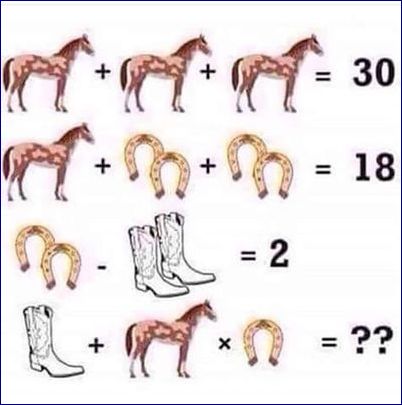
Which number should replace the question mark?

Triangular Logic

Asked by Neha on 11 Aug 2023


Can you replace the question mark with the correct letter?

6 + 6 + 6 = N
7 + 7 + 7 = E
8 + 8 + 8 = R
0 + 0 + 0 = ?

Asked by Neha on 08 Jul 2024

What 4-letter word can be written forward, backward or upside down, and can still be read from left to right?

Asked by Neha on 14 May 2021


What is in seasons, seconds, centuries and minutes but not in decades, years or days?

Asked by Neha on 25 Dec 2024

There is a wide field of corn. A goose finds its way into the field and starts running. Can you find out till which point the goose can run into the field?

Asked by Neha on 27 Oct 2023

Divide 110 into two parts so that one will be 150 per cent of the other. What are the 2 numbers?

Asked by Neha on 27 Oct 2024


How many triangles can you find in this given picture?

Count the Triangles

Asked by Neha on 27 Feb 2023

You can win me and lose me but never buy me
You can not eat me and never want to part with me
I can make you cry or bring you joy
I am not a machine and definitely not a toy
You keep me but i am not forever just yours
You might find me in a case or on a shelf next to a vase
I am hard and i am tall if you bump me i am sure to fall
I am made of different materials and am at many events
If your lucky and fight hard I might be yours
What am I ?

Asked by Neha on 11 May 2021

James bond was pushed out of an aeroplane without any parachute.
He survived, How come?

Asked by Neha on 28 Sep 2024


What word begins and ends with an E, but has only one letter?

Asked by Neha on 21 Oct 2021

Hot Articles

Amazing Facts

Crossword puzzles

In the 1920s, people feared that crossword puzzles would contribute to illiteracy.