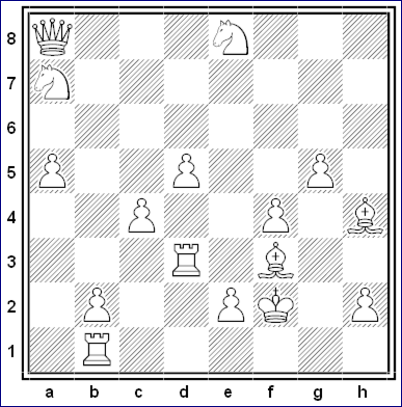
In the Chess Board picture below white army is arranged. You need to add a black army on the board such that no piece is under any threat.
Note: Army comprised of 1 king, 1 queen, 2 rooks, 2 bishops, 2 knights, and 8 pawns.
John is on an island and there are three crates of fruit that have washed up in front of him. One crate contains only apples. One crate contains only oranges. The other crate contains both apples and oranges.
Each crate is labelled. One reads 'apples', one reads 'oranges', and one reads 'apples and oranges'. He know that NONE of the crates have been labeled correctly - they are all wrong.
If he can only take out and look at just one of the pieces of fruit from just one of the crates, how can he label all of the crates correctly?
This is a famous paradox which has caused a great deal of argument and disbelief from many who cannot accept the correct answer. Four balls are placed in a hat. One is white, one is blue and the other two are red. The bag is shaken and someone draws two balls from the hat. He looks at the two balls and announces that at least one of them is red. What are the chances that the other ball he has drawn out is also red?
James ordered a fishing rod, priced at $3.56. Unfortunately, James is an Eskimo who lives in a very remote part of Greenland and the import rules forbid any package longer than 4 feet to be imported. The fishing rod was 4 feet and 1 inch, just a little too long, so how can the fishing rod be mailed to James without breaking the rules? Ideally James would like the fishing rod to arrive in one piece!
John is pretty weird. He likes toffees but hates chocolates. He loves books but never reads. He likes to build his troops in an online game but does not proceed with the war. He likes to go swimming but is afraid of water.
Seeking this behaviour, can you tell whether he likes balloons and parties?