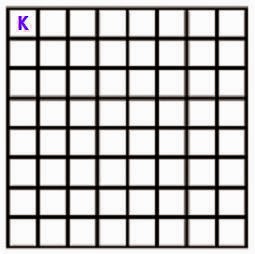
In the picture, you can see a chess board. On the top left position, the K marks a knight. Now, can you move the knight in a manner that after 63 moves, the knight has been placed at all the squares exactly once excluding the starting square?
This is a famous paradox which has caused a great deal of argument and disbelief from many who cannot accept the correct answer. Four balls are placed in a hat. One is white, one is blue and the other two are red. The bag is shaken and someone draws two balls from the hat. He looks at the two balls and announces that at least one of them is red. What are the chances that the other ball he has drawn out is also red?
There are hundred red gems and hundred blue gems. The blue gems are priceless while the red gems equal wastage. You have two sacks one labeled Heads and the other Tails. You have to distribute the gems as you want in the two sacks. Then a coin will be flipped and you will be asked to pick up a gem randomly from the corresponding sacks.
How will you distribute the gems between the sacks so that the odds of picking a Blue gem are maximum?
Follow the rules.
=> Each digit should be used only once.
=> You can only use addition.
=> For making a number, two single digits can be combined (for example, 4 and 2 can be combined to form 42 or 24)
=> A fraction can also be made by combining the two single digits (for example, 4 and 2 can be combined to form 4/2 or 2/4)
In 2011, people playing Foldit, an online puzzle game about protein folding, resolved the structure of an enzyme that causes an Aids-like disease in monkeys. Researchers had been working on the problem for 13 years. The gamers solved it in three weeks.