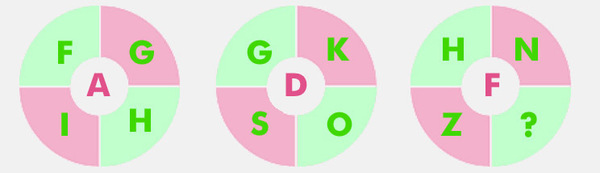
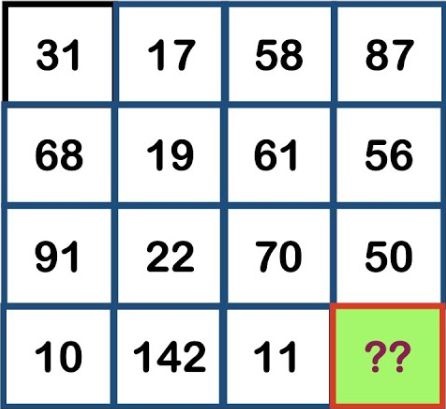
* When we multiply three numbers, we will get the prime numbers.
* The difference between the second and the first number is equal to the third and second.
Three men in a cafe order a meal the total cost of which is $15. They each contribute $5. The waiter takes the money to the chef who recognises the three as friends and asks the waiter to return $5 to the men.
The waiter is not only poor at mathematics but dishonest and instead of going to the trouble of splitting the $5 between the three he simply gives them $1 each and pockets the remaining $2 for himself.
Now, each of the men effectively paid $4, the total paid is therefore $12. Add the $2 in the waiters pocket and this comes to $14. Where has the other $1 gone from the original $15?
A farmer went to a market and bought a wolf, a goat, and a cabbage. On his way home, the farmer came to the bank of a river and rented a boat. But crossing the river by boat, the farmer could carry only himself and a single one of his purchases: the wolf, the goat, or the cabbage. If left unattended together, the wolf would eat the goat, or the goat would eat the cabbage. The farmer’s challenge was to carry himself and his purchases to the far bank of the river, leaving each purchase intact. How did he do it?
In a science lab, a petri dish hosts a healthy colony of yeast for an experiment. Now every minute, all the yeast cells divide into two. At noon, there was just a single cell of yeast and at 1:22, the Petri dish was half full. Can you calculate when the dish will be full of yeast?
A woman lives in a skyscraper thirty-six floors high and is served by several elevators which stop at each floor going up and down. Each morning she leaves her apartment and goes to one of the elevators. Whichever one she takes is three times more likely to be going up than down. Why?
The two towns are exactly 100 km apart. John leaves City A driving at 30 km/hr and Jacob leaves City B half an hour later driving at 60 km/hr. Who will be closer to City A when they meet?