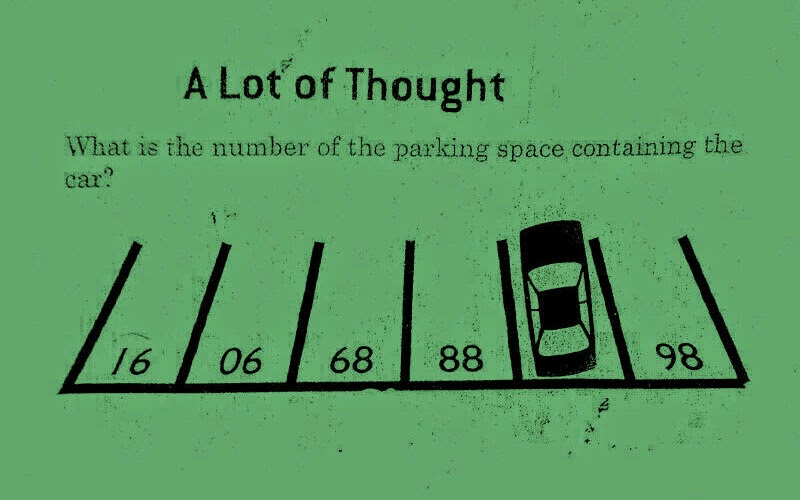
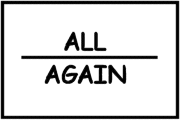
There is a box in which distinct numbered balls have been kept. You have to pick two balls randomly from the lot.
If someone is offering you a 2 to 1 odds that the numbers will be relatively prime, for example
If the balls you picked had the numbers 6 and 13, you lose $1.
If the balls you picked had the numbers 5 and 25, you win $2.
A chicken farmer has figured out that a hen and a half can lay an egg and a half in a day and a half. How many hens does the farmer need to produce one dozen eggs in six days?
Three men in a cafe order a meal the total cost of which is $15. They each contribute $5. The waiter takes the money to the chef who recognises the three as friends and asks the waiter to return $5 to the men.
The waiter is not only poor at mathematics but dishonest and instead of going to the trouble of splitting the $5 between the three he simply gives them $1 each and pockets the remaining $2 for himself.
Now, each of the men effectively paid $4, the total paid is therefore $12. Add the $2 in the waiters pocket and this comes to $14. Where has the other $1 gone from the original $15?
Using four sevens (7) and a one (1) create the number 100. Except for the five numerals, you can use the usual mathematical operations (+, -, x, :), root and brackets ()
You have a basket containing ten apples. You have ten friends, who each desire an apple. You give each of your friends one apple.
Now all your friends have one apple each, yet there is an apple remaining in the basket.
How?
Find a 9-digit number, which you will gradually round off starting with units, then tenth, hundred etc., until you get to the last numeral, which you do not round off. The rounding alternates (up, down, up ...). After rounding off 8 times, the final number is 500000000. The original number is commensurable by 6 and 7, all the numbers from 1 to 9 are used, and after rounding four times the sum of the not-rounded numerals equals 24.