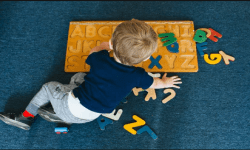
Everyone Know me

Twice ten are six of us,

Six are but three of us,

Nine are but four of us;

What can we possibly be?

Would you know more of us?

Twelve are but six of us,

Five are but four, do you see?

What are we?


Similar Riddles

There is an English word that can be used up to four times in a row without modifying the spelling and form a valid grammatical sentence.

Do you know what word is that?

Asked by Neha on 18 Aug 2024


John has eleven friends. He has a bowl containing eleven apples. Now He wants to divide the eleven apples among his friends, in such a way that an apple should remain in his bowl.
How can He do it?

Asked by Neha on 05 Mar 2025

If you had a pizza with crust thickness 'a' and radius 'z', what's the volume of the pizza?

Asked by Neha on 30 May 2024


How can you tell a raw egg from a hard-boiled egg?

Asked by Neha on 09 Jan 2025

I am thinking of a five-digit number such that:
The first and last digits are the same, their submission is an even number and multiplication is an odd number and is equal to the fourth number. Subtract five from it and we obtain the second number. Then divide into exact halves and we get the 3rd number.

What number I am thinking of?

Asked by Neha on 16 Nov 2024

Why is a river so rich ?

Rich River Riddle

Asked by Neha on 24 Dec 2020


There is a brick of gold and a brick of iron in a boat (both 10-inch blocks), if they are both dropped into the water which will make the water level higher?

Gold and Iron Bricks

Asked by Neha on 27 May 2024

I can be cracked, made, told, and played. What am I?

Asked by Neha on 16 Aug 2025

Can you find the next number in the below sequence
3 , 7 , 10 , 11 , 12 , 17 ?

Asked by Neha on 04 Mar 2025


What common phrase is represented by the below lines

Easy going:
Weak, 'I'm going.'
Tough, 'I'm staying.'

Medium going:
Weak, 'I'm going.'
Tough, 'I'm staying.'

Tough going:
Weak, 'I can't do it, I'm staying!'
Tough, 'Let's get going.'

Asked by Neha on 19 Nov 2024

Hot Articles

Amazing Facts

Crossword puzzles

In the 1920s, people feared that crossword puzzles would contribute to illiteracy.