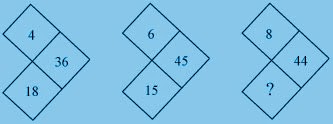
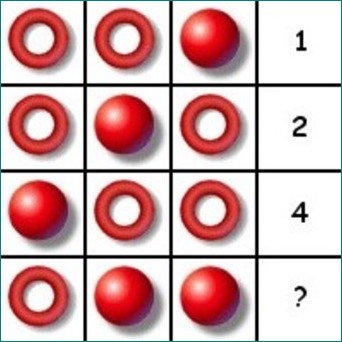
A man has eighty-one cows ( numbered 1,2,3...81 as such). The beauty is that cow no. 1 gives 1ltr of milk, cow no. 2 gives 2ltrs of milk and so on. The man wants to equally distribute the cows among his nine sons so that each one of them gets the same quantity of milk.
Below, you will find the mathematical proof that 10 equals 9.99999?. But is that possible or there is something wrong about it? Can you find the error?
x = 9.999999...
10x = 99.999999...
10x - x = 90
9x = 90
x = 10
Using four sevens (7) and a one (1) create the number 100. Except for the five numerals, you can use the usual mathematical operations (+, -, x, :), root and brackets ()
John was running from 40 thieves. John has got 3 gold boxes which weigh as 4kg, 2kg, and 1kg respectively. A witty man asked John to stay with him for seven days in exchange for 1kg gold per day. John needs to stay there for seven days and also do not want to give the witty man any advance. How can John pay for his seven days stay?
Follow the rules.
=> Each digit should be used only once.
=> You can only use addition.
=> For making a number, two single digits can be combined (for example, 4 and 2 can be combined to form 42 or 24)
=> A fraction can also be made by combining the two single digits (for example, 4 and 2 can be combined to form 4/2 or 2/4)
A rain drop fell from one leaf to another leaf and lost 1/4th of its volume. It then fell to another leaf and lost 1/5th of the volume. It again fell on another leaf and lost 1/5th of the volume.
This process kept repeating till it fell on the last leaf losing 1/75th of its volume.
Can you calculate the total percentage of loss from the initial volume when the drop has fallen to the last leaf accurate up to two decimal places?
A famous swimmer can swim downstream in a lake in exactly 40 minutes with the lake current.
He can swim upstream in that lake in exactly 60 minutes against the lake current.
The length of the lake is 2 km.
How long he can cover the distance of one side at a still lake with no current?