Three men in a cafe order a meal the total cost of which is $15. They each contribute $5. The waiter takes the money to the chef who recognises the three as friends and asks the waiter to return $5 to the men.
The waiter is not only poor at mathematics but dishonest and instead of going to the trouble of splitting the $5 between the three he simply gives them $1 each and pockets the remaining $2 for himself.
Now, each of the men effectively paid $4, the total paid is therefore $12. Add the $2 in the waiters pocket and this comes to $14. Where has the other $1 gone from the original $15?
John, a 5-year-old boy, was really fond of the chocolates. He asked his Mother to give him some money to buy his favourite chocolates. His Mother gave him $45. He went to the shopkeeper and asked, "How much is one chocolate for?". The shopkeeper said $3 for one chocolate. Also, if you give me the wrappers of three chocolates, I will give you one for the exchange.
In total, how much chocolate could John eat?
This is a famous paradox which has caused a great deal of argument and disbelief from many who cannot accept the correct answer. Four balls are placed in a hat. One is white, one is blue and the other two are red. The bag is shaken and someone draws two balls from the hat. He looks at the two balls and announces that at least one of them is red. What are the chances that the other ball he has drawn out is also red?
A pregnant woman is preparing to name her seventh child. Her children's names so far are Dominique, Regis, Michelle, Fawn, Sophie, and Lara. What will she name her next child -- Jessica, Katie, Abby or Tilly?
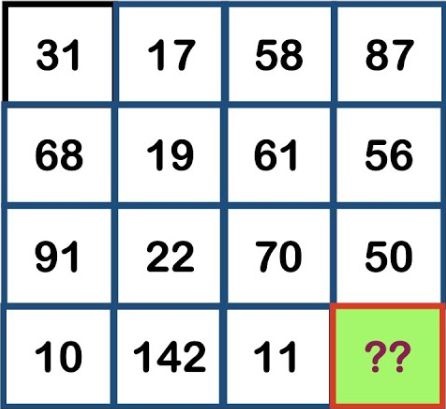
The below given figure comprises of a pattern through which you can determine the missing letter. Can you push your mind to find the pattern and add the missing letter?