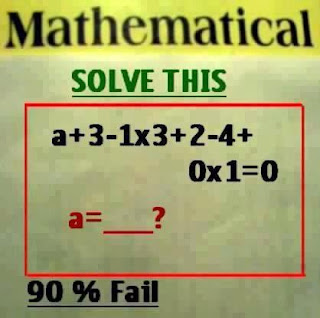
Use the numbers 2, 3, 4 and 5 and the symbols + and = to make a true equation. Conditions: Each must be used exactly once and no other numbers or symbols can be used.
A man died and leaves Rs.10,000 in his will. There are 6 beneficiaries- his 3 sons and their wives. The 3 wives receive Rs.3960 of which Priyanka gets Rs.100 more than Tanu and Neha gets Rs.100 more than Priyanka.
Pramod gets twice as much as his wife, Tushar gets the same as his wife, and Prashant gets 50% more than his wife.
A man had five children. He had $100 with him to give to his children. He decided to start with the youngest child and then give $2 more than each younger child to his next elder child.
For example, if he gives $x to the youngest child, he will give $(x+2) to the next one, $[(x+2) + 2] to the next one and so on.
Can you find out how much did the youngest one receive?
A four-digit number (not beginning with 0) can be represented by ABCD. There is one number such that ABCD=A^B*C^D, where A^B means A raised to the B power. Can you find it?
In 2011, people playing Foldit, an online puzzle game about protein folding, resolved the structure of an enzyme that causes an Aids-like disease in monkeys. Researchers had been working on the problem for 13 years. The gamers solved it in three weeks.