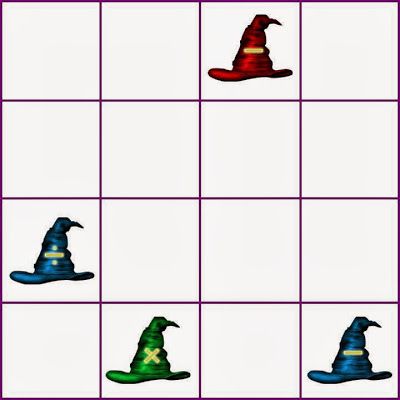
Three people enter a room and have a green or blue hat placed on their heads. They cannot see their own hat but can see the other hats.
The colour of each hat is purely random. They could all be green, blue, or any combination of green and blue.
They need to guess their own hat colour by writing it on a piece of paper, or they can write 'pass'.
They cannot communicate with each other in any way once the game starts. But they can have a strategy meeting before the game.
If at least one of them guesses correctly they win $10,000 each, but if anyone guesses incorrectly they all get nothing.
What is the best strategy?
John needs to purchase 100 chocolates from three different shops and he has exactly 100 rupees to do that which he must spend entirely. He must buy at least 1 Chocolate from each shop.
The first shop is selling each chocolate at 5 paise, the second is selling at 1 rupee and the third is selling at 5 rupees.
An inspection by the superintendent of St. Joseph School was scheduled on the next day. The class teacher Jenifer knew that he would be asking questions from her class and she would have to choose a pupil to answer. To offer a perfect impression over him, the teacher explained certain instructions to the students to maximise the chances of getting correct answer every time.
Samuel was out for a walk when it started to rain. He did not have an umbrella and he wasn't wearing a hat. His clothes were soaked, yet not a single hair on his head got wet. How could this happen?
A boy collects white seashells from the sea and brings them home every night. When he has enough of them, he decides to sell them to a trader.
The trader is ready to buy the shells and he asks the boy about the quantity. At this, the boy starts calculating. He has a giant box that contains 3 mini boxes. Two of them have another mini box inside. If the giant box can hold 50 shells, how many brown shells can he sell to the trader?
You are provided with a grid (as shown in the picture). Can you fill the squares with numbers 1-8 in a manner that none of the two consecutive numbers are placed next to each other in any direction (vertically, horizontally or diagonally?)
Artificial Intelligence has crushed all human records in the puzzle game “2048,” achieving a high score of 839,732 and beating the game in only 973 moves without using any undo.