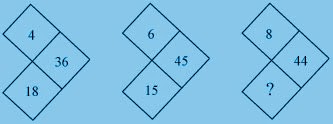
A man had five children. He had $100 with him to give to his children. He decided to start with the youngest child and then give $2 more than each younger child to his next elder child.
For example, if he gives $x to the youngest child, he will give $(x+2) to the next one, $[(x+2) + 2] to the next one and so on.
Can you find out how much did the youngest one receive?
A tree doubled in height each year until it reached its maximum height over the course of ten years. How many years did it take for the tree to reach half its maximum height?
Chocolate costs 6 rupees and a Toy costs 5 rupees. If you have 32 rupees in total, how many chocolates and how many Toys can be purchased with that amount?
Find out a multi-digit number that if multiplied by the number 9 or any of its multiplications products (i.e. 18, 27, 36, 45,..) will result in the multiplication factor repeated (n) number of times.
Using four sevens (7) and a one (1) create the number 100. Except for the five numerals, you can use the usual mathematical operations (+, -, x, :), root and brackets ()
A man has eighty-one cows ( numbered 1,2,3...81 as such). The beauty is that cow no. 1 gives 1ltr of milk, cow no. 2 gives 2ltrs of milk and so on. The man wants to equally distribute the cows among his nine sons so that each one of them gets the same quantity of milk.
A four-digit number (not beginning with 0) can be represented by ABCD. There is one number such that ABCD=A^B*C^D, where A^B means A raised to the B power. Can you find it?
Artificial Intelligence has crushed all human records in the puzzle game “2048,” achieving a high score of 839,732 and beating the game in only 973 moves without using any undo.