I can sizzle like bacon,
I am made with an egg,
I have plenty of backbone, but lack a good leg,
I peel layers like onions, but still remain whole,
I can be long, like a flagpole, yet fit in a hole.
A man is surviving on an island along with his friend. They have been starving for four days for food. Suddenly, they find a fisherman. The friend goes with the fisherman in order to catch the fish (if they can find any).
The fisherman returns after some time but he is alone and has some salmon that he had prepared. When asked, the fisherman tells him that his best friend fell off the boat and drowned in the water. Starving for so long, he eats the meal while crying for his friend.
After being rescued, he goes to a diner and orders salmon. When he eats his meal, he jumps and commits suicide. Why did he do it?
A man is walking down a road with a basket of eggs. As he
is walking he meets someone who buys one-half of his eggs
plus one-half of an egg.
He walks a little further and meets another person who buys
one-half of his eggs plus one-half of an egg.
After proceeding further he meets another person who buys
one-half of his eggs plus one half an egg. At this point, he
has sold all of his eggs, and he never broke an egg.
How many eggs did the man have to start with?
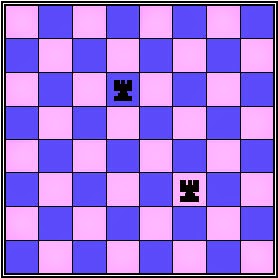
In the attached figure, you can see a chessboard and two rooks placed on the chess board. What you have to find is the number of squares that do not contain the rooks. How many are there?
There are hundred red gems and hundred blue gems. The blue gems are priceless while the red gems equal wastage. You have two sacks one labeled Heads and the other Tails. You have to distribute the gems as you want in the two sacks. Then a coin will be flipped and you will be asked to pick up a gem randomly from the corresponding sacks.
How will you distribute the gems between the sacks so that the odds of picking a Blue gem are maximum?
Three people enter a room and have a green or blue hat placed on their heads. They cannot see their own hat but can see the other hats.
The colour of each hat is purely random. They could all be green, blue, or any combination of green and blue.
They need to guess their own hat colour by writing it on a piece of paper, or they can write 'pass'.
They cannot communicate with each other in any way once the game starts. But they can have a strategy meeting before the game.
If at least one of them guesses correctly they win $10,000 each, but if anyone guesses incorrectly they all get nothing.
What is the best strategy?
A famous swimmer can swim downstream in a lake in exactly 40 minutes with the lake current.
He can swim upstream in that lake in exactly 60 minutes against the lake current.
The length of the lake is 2 km.
How long he can cover the distance of one side at a still lake with no current?