Rounding Off Numbers

Find a 9-digit number, which you will gradually round off starting with units, then tenth, hundred etc., until you get to the last numeral, which you do not round off. The rounding alternates (up, down, up ...). After rounding off 8 times, the final number is 500000000. The original number is commensurable by 6 and 7, all the numbers from 1 to 9 are used, and after rounding four times the sum of the not rounded numerals equals 24.



Similar Math Riddles

There is a straight highway. Four different villages lie on that highway. The distance between them is different. The third village is 60km away from the first village; the fourth is 40 km away from the second; the third is 10 km near to the fourth that it is to the second.

Can you calculate the distance between the fourth and the first village ?

Asked by Neha on 23 Mar 2023


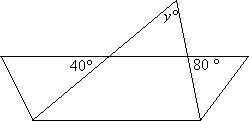
In the image below, can you find the value of an angle(y)

The angle of a triangle

Asked by Neha on 17 May 2023

There is a hypothetical state between the USA and Mexico border 'Tango'.
Here 70 percent of the population have defective eyesight, 75 percent are hard of hearing, 80 percent have Nose trouble and 85 percent suffer from allergies, what percentage (at a minimum) suffer from all four ailments?

Asked by Neha on 17 May 2024


In a school, there are four subjects. Seventy percent of students study English, seventy five percent of students study Science, eighty five percent of students study Mathematics and eighty percent of students study Spanish.

Can you calculate the percentage of students that study all four subjects?

Asked by Neha on 16 Apr 2023

What is the largest number you can write with just 3 digits?

Asked by Neha on 18 Apr 2025

Three friends decide to distribute the soda cans they had among them. When all of them had drunk four cans each, the total number of cans that remained was equal to the cans each one of them had after they had divided the cans.

Can you calculate the total number of cans before distribution?

Asked by Neha on 12 May 2025


You have two jars of chocolates labelled as P and Q. If you move one chocolate from P to Q, the number of chocolates on B will become twice the number of chocolates in A. If you move one chocolate from Q to P, the number of chocolates in both the jars will become equal.

Can you find out how many chocolates are there in P and Q respectively?

Asked by Neha on 11 Apr 2023

A generous owner of a company decided to give a bonus of $45 to every man and $60 to every woman on his birthday. But only one-ninth of the men and one-twelfth of the women were present to take the bonus.

Can you calculate the amount of money the owner spent if there were 3552 employees?

Asked by Neha on 26 Nov 2024

A cricket has 6 legs, a squirrel has 4 legs and a spider has 8 legs.

In a local zoo, it was found that the total number of legs is 612. Also, there are equal number of each of the above animals/insects.

Can you find out how many animals are there in the zoo?

Asked by Neha on 06 Feb 2021


A man has eighty-one cows ( numbered 1,2,3...81 as such). The beauty is that cow no. 1 gives 1ltr of milk, cow no. 2 gives 2ltrs of milk and so on. The man wants to equally distribute the cows among his nine sons so that each one of them gets the same quantity of milk.

Asked by Neha on 05 Jan 2024

Hot Articles

Amazing Facts

Crossword

The day before the 1996 U.S. presidential election, the NYT Crossword contained the clue “Lead story in tomorrow’s newspaper,” the puzzle was built so that both electoral outcomes were correct answers, requiring 7 other clues to have dual responses.