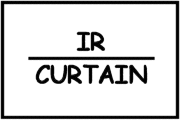
During an experiment, a guy throws a bouncy ball from a 100 feet tall building. The ball has a specific characteristic. Every time it hits the ground, it bounces up halfway.
How many bounces do you think the ball will make before it comes to a stop ?
While preparing the table for dinner, wife came up with an idea to tease his mathematician husband. She asked her husband to pick nine toothpicks and make ten without breaking any toothpick.
The husband was also smart and did it within seconds. How ?
In a box, there is a jumble of 7 red balls, 6 blue balls, 5 green balls, and 4 yellow balls. What is the minimum number of balls, will you have to pick up so that you have at least 4 balls of the same colour?
A car meter reading shows 72927 miles a palindromic number.
what is the minimum number of miles you would need to travel to see another palindromic number on the car meter reading?
I drive at an average speed of 30 miles per hour to the railroad station each morning and catch my train. On a particular morning, there was a lot of traffic and at the halfway point, I had averaged only 15 miles per hour. How fast must I drive for the rest of the way to catch my train?
It can't be seen, can't be felt, can't be heard, and can't be smelt.
It lies behind stars and under hills, And empty holes it fills.
It comes first and follows after, Ends life, and kills laughter.
What is it?
On 26-01-2022, Juli was murdered at her house in a city in India in the afternoon. There were three suspects in the murder and the following are the statements that were given by them:
John: I visited my village that day.
Jacob: I was out to deposit my house tax in the municipality office at that time.
Jonny: I was at a friend's place having lunch at that time.
The day before the 1996 U.S. presidential election, the NYT Crossword contained the clue “Lead story in tomorrow’s newspaper,” the puzzle was built so that both electoral outcomes were correct answers, requiring 7 other clues to have dual responses.