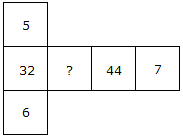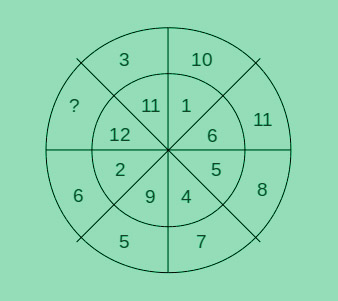
Assume the given figure to be a delicious doughnut. Yes, now you can concentrate more on the puzzle. So you have this delicious doughnut in your refrigerator when your friends come knocking at the door. There are eight of them. Now you have to make three cuts in this doughnut so that each one of you nine people can enjoy a piece of it. Neither you nor your friends would mind the size of their piece as long as they are getting it. How will you do it?
You have a thousand Re. 1 coins with you. You have ten bags with you and you can put any number of coins in each of the bags. The condition is that if someone asks you for any amount between 1 and 1000, you must be able to give that amount by just giving the bag (you are not allowed to open the bag and give coins).
Jessica is telling her friends this story and asks them to guess if it’s the truth or a lie: “There was a man sitting in a house at night that had no lights on at all. There was no lamp, no candle, and no other source of light. Yet, he sat in the house and read his book happily.†Her friends say she’s lying, but Jessica corrects them and says she’s telling the truth. Jessica’s story is true—but how?
A research team went to a village somewhere between the jungles of Africa. Luckily for them, they reached the day when quite an interesting custom was to be performed. The custom was performed once a year as they confirmed and was performed in order to collect the taxes from every male of the region.
The taxes were to be paid in the form of grains. Everyone must pay pounds of grain equaling his respective age. This means a 20-year-old will have to pay 20 pounds of grain and a 30-year-old will pay 30 pounds of grain and so on.
The chief who collects the tax has 7 weights and a large 2-pan scale to weigh. But there is another custom that the chief can weigh only three of the seven weights.
Can you find out the weights of the seven weights? Also, what is the maximum age of the man that can be weighed for the payment of taxes?