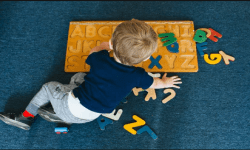
Puzzle in a Puzzle

What are the next two letters in the following series and why?
W A T N T L I T F S _ _

*Hint: Check Puzzle Title


Similar Logic Riddles

Mr. Buttons was all set to go to the village of Buttonland to meet his friend. So, he packed his bags and left for the village at 5 in the morning. Upon travelling on a road for miles, he came across a point where the road diverged into two. He was confused on which road to take. He gazed around and he saw two owls sitting on a branch. He thought he could ask for directions for the village from the two owls. So he went to the tree. There he saw a sign which read, "One owl always lies, and one is always truthful. They both fly away if you ask them more than 1 question."
Mr. Buttons was caught in the dilemma of what to ask? And from which owl to ask, since he only had one question. What should Mr. Buttons ask?

Asked by Neha on 18 Aug 2021


Solve the below puzzle by replacing the question mark with the correct number.

3 6 12

4 8 16

5 10 ?

Asked by Neha on 12 Apr 2025

The following four words might seem abrupt to you. But you can make them meaningful by just adding vowels.
RDSH
GGPLNT
TMT
NN

Hint: All of them are vegetables.

Asked by Neha on 13 Nov 2025


Using the clues below, what four numbers am I thinking of?

The sum of all the numbers is 31.
One number is odd.
The highest number minus the lowest number is 7.
If you subtract the middle two numbers, it equals two.
There are no duplicate numbers.

Asked by Neha on 06 Jan 2025

Four people need to cross a rickety bridge at night. Unfortunately, they have only one torch and the bridge is too dangerous to cross without one. The bridge is only strong enough to support two people at a time. Not all people take the same time to cross the bridge. Times for each person: 1 min, 2 mins, 7 mins and 10 mins. What is the shortest time needed for all four of them to cross the bridge?

Asked by Neha on 24 Aug 2023

Can you find the odd number in the following five choices?

1) 482636
2) 259807
3) 865195
4) 104739
5) 391744

Asked by Neha on 24 Nov 2024


John, a 5-year-old boy, was really fond of the chocolates. He asked his Mother to give him some money to buy his favourite chocolates. His Mother gave him $45. He went to the shopkeeper and asked, "How much is one chocolate for?". The shopkeeper said $3 for one chocolate. Also, if you give me the wrappers of three chocolates, I will give you one for the exchange.
In total, how much chocolate could John eat?

Asked by Neha on 02 Feb 2026

Alex opened 24 presents
Jonah opened 8 presents
Clara opened 1 present

Can you find out how many presents were opened by Candy?

Asked by Neha on 06 May 2024

A solo dice game is played. In this game, upon each turn, a normal pair of dice is rolled and the score is calculated not by adding the numbers but multiplying them.

In a particular game, the score for the second roll is five more than what was achieved in the first roll. The score for the third roll is six less than what was completed in the second roll. The score for the fourth roll is eleven more than what was achieved in the third. The score for the fifth roll is eight less than what was completed in the fourth.

Can you calculate the score for each of the five throws?

Asked by Neha on 04 Jun 2024


You are given a set of weighing scales and 12 marbles. The scales are of the old balance variety. That is, a small dish hangs from each end of a rod that is balanced in the middle. The device enables you to conclude either that the contents of the dishes weigh the same or that the dish that falls lower has heavier contents than the other. The 12 marbles appear to be identical. 11 of them are identical, and one is of a different weight. Your task is to identify the unusual marble and discard it. You are allowed to use the scales three times if you wish, but no more. Note that the unusual marble may be heavier or lighter than the others. You are asked to both identify it and determine whether it is heavy or light

Asked by Neha on 02 Apr 2026

Hot Articles

Amazing Facts

Gambling

In Canada, a mathematical puzzle must be solved in order to win the lottery to classify it as a “game of skill” not gambling.